» » Opus Ill - Opus III & Friends
Opus Ill - Opus III & Friendsh1
Rock
Performer: Opus Ill
Title: Opus III & Friends
Year 1970
Country Europe
Genre: Rock
Rating: 4.7
Votes: 391
MP3 size: 1290 mb
FLAC size: 1357 mb
WMA size: 1897 mb
Other formats: DMF MP1 WMA MMF MP3 ASF XM

Opus Ill - Opus III & Friends mp3 album


Opus Ill - Opus III & Friends mp3 album

Tracklist

A1 6.30 A Sunday Morning
A2 General Mojo's Well Laid Plan
A3 I See The World From My Window
A4 Natural Talking Boy
B1 Movements Of 8.08 Time-series
B2 Juice Of Joy
B3 Deserted Child
B4 Evening Dream

Credits

  • Bass – Björn Stolt
  • Design – Leif Illernäs
  • Drums – Ola Brunkert
  • Engineer – Åke Eldsäter
  • Guest, Choir – A. C. Tenderfoot, Herbert Reberstack, Simon Hair
  • Guest, Piano – Johannes Olsson
  • Guest, Piano, Flute – Björn Lindh*
  • Guest, Vocals – Richard Camembert, Troy Dunne
  • Guitar, Vocals – Janne Schaffer
  • Photography – Bengt af Geijerstam
  • Producer – Claes af Geijerstam

Other versions

Category Artist Title (Format) Label Category Country Year
SLP-2508 Opus Ill* Opus III & Friends ‎(LP, Album, Ltd, RE, Num) Sonet SLP-2508 Europe 2013


Riavay
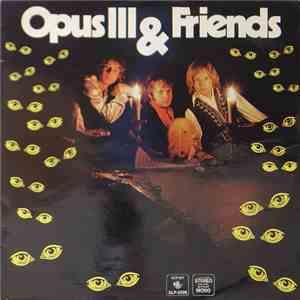
This is a wonderful review that was on an ebay listing from 2007 NOT WRITTEN BY ME. Author unknown."This is why I hate labels. Not that this uber-rare Swedish album from 1970 by Opus III and Friends shows up very often – you’re likely to see six dozen original pressings of the July album for every one of these, and that’s not an exaggeration – but when it does, record dealers always – and I mean, always – label it “progressive rock.” Now I don’t know about you, but when I think prog-rock, I think of long instrumental passages, intricate time signatures and music that often incorporates elements of classical works and/or jazz fusion. Opus III and Friend’s first song, “6:30 A Sunday Morning” filches bits from two Cream songs in the first minute, and then references the Beatles. Now if that’s prog rock, then Roger Dean shoulda designed the cover for “Disraeli Gears.” I’ll give you bands like the Nice and Flaming Youth, and albums like Yes’s “Time and A Word” – you could slap either a “prog” or a “psych” label on those and make a case both ways. And I’ll also concede that Opus III and Friends’ album came out in 1970, that notoriously transitional year between both genres. But one listen to this album and you’ll hear influences from Cream, the Beatles, Jimi Hendrix, Pink Floyd, the Yardbirds and Santana, only one of which you might classify as prog rock. Besides, the Swedes were always a little behind the trends – heck, Abba’s “Dancing Queen” didn’t come out til 1977, three years after the birth of disco! Whatever you wanna call it, the few lucky people who’ve heard it all agree that it’s a true lost gem – so obscure and buried in the annals of rock history, I don’t think anyone’s ever even written about it before. It’s certainly not been reissued, and it’ll probably stay that way. So if you’re wondering where this one came from, you’re not alone. Now let’s show you what you’ve been missing. The aforementioned opener, “6:30 A Sunday Morning”, charges out of the gate with not one but two quick references to Cream – the opening riff and chorus sound awfully close to “Badge” while the verses borrow from “I Feel Free.” There’s also a quick Beatles swipe, when they sing “Life is very short” nearly the same way Paul did in “We Can Work it Out,” and in just the first minute of the album, you’re wondering if these Swedes aren’t swiping more ideas than the design department of Ikea. But as the song progresses, it also relaxes a little, and soon the band stretches out into the loose, jammy acid rock vibe of West Coast bands like Spirit, Quicksilver Messenger Service and Mad River. Two excellent, smokin’ guitar solos later, and you wonder if any one who saw QMS play at the Avalon Ballroom in 1968 was thinking “prog rock.” The remainder of Side 1 floats into jazz rock territory – but don’t get too excited, Henry Cow fans – we’re talking more of a hippie Monterey Pop communal jazz vibe, rather than a studied Canterbury prog jazz thing. Expect great things from a title like “General Mojo’s Well Laid Plan” and it won’t let you down – especially if you’re a fan of the pretty Jimi Hendrix ballads like “Little Wing” and “Angel.” This one’s strictly instrumental, though, which gives Opus III vocalist and guitarist Janne Schaffer more of an opportunity to fire off some killer fluid, liquidy guitar leads – in the grand Hendrix tradition. For “Natural Talking Boy”, the vibe is even looser, even jazzier, with a great rolling tribal rhythm section. If this sounded any more like a live Santana jam, it’d be pouring outside. Maybe a title like “Movements of 8:08 Time Series Analyses” might smack of prog rock, and someone just casually reading off the song list without actually listening to this album could conceivably be misled into thinking this was some early 70’s Scandinavian space rock epic like Algarnas Tradgard or something. But they’d be wrong, just like the song title. It runs 8:13. No, this is much headier stuff than that. And it all comes to a close with the trippiest, most psychedelic offering yet, “Evening Dream,” a cosmic brew of sound waves and real waves, and if ever a song could be described as “washing over you,” it’s this one. Thanks to some trippy cymbal crashes and the sound effects of waves crashing on the shore. It’s Country Joe and the Fish’s “Magoo” colliding with Pink Floyd’s “Echoes,” - the Avalon Ballroom meets the UFO Club and settles somewhere in Malmo. Some Benedictine monks show up for the performance and chant softly in the background, bringing to mind the more headier Yardbirds tracks, like “Turn to Earth” and “Still I’m Sad.” It’s all one giant aural brain wash, and even if it veers dangerously close to new age during the acoustic guitar solo, it bounces back to psych rock with a vengeance for the grand finale – all cymbal crashes, monk chants and crashing waves. The only prog rock in 1970 that was this f&*^ed up had a cow on the cover. It’s a hard record to explain, just like it’s hard to explain the swarm of disembodied glowing yellow eyes that flank the band on the front cover. In the end, a simple label like “prog” or “psych” or even “underground rock” doesn’t even begin to explain the lysergic head zones and twisted terrains these three Swedes carve out. It’s just like Swedish meatballs. You’re not really how it’s made (and it’s probably best you don’t know), you just know it’s good when it’s finished."
Granijurus
Here's a link to the third track:https://youtu.be/4tSWQviJz_Q